
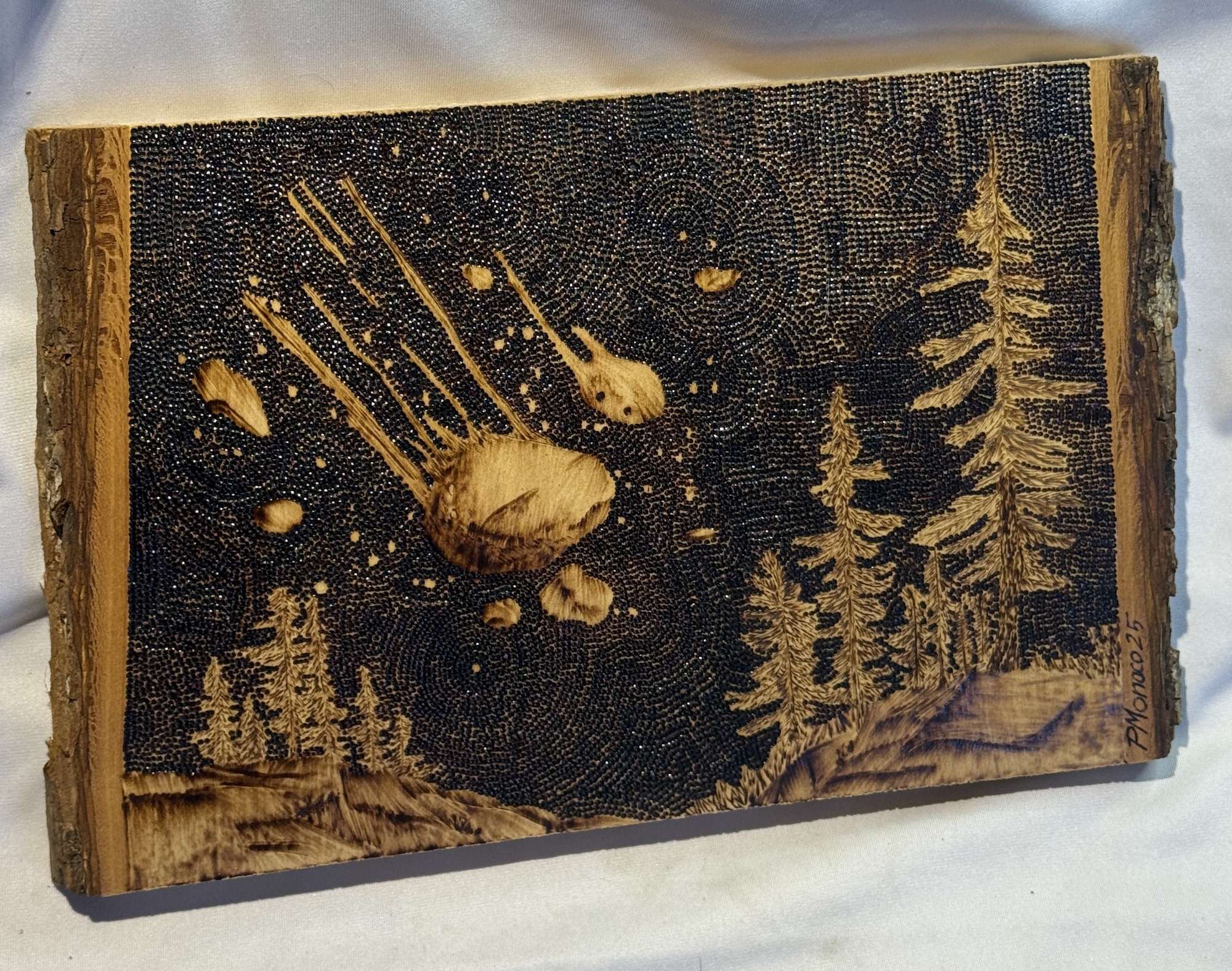
I didn’t discover pyrography in a neat, cinematic moment. There was no angelic choir. No aha! spotlight.
It showed up quietly. Like most things that end up saving you.
At the time, my life was already full, too full, if I’m honest. Full of responsibility. Full of worry. Full of trying to hold everything together with both hands while pretending my arms weren’t shaking. Creativity wasn’t something I felt entitled to. It was something I admired from a distance, the way you admire a trail you don’t believe you’re strong enough to hike.
Fire wasn’t part of the plan. Survival was.
But here’s the thing I didn’t understand back then: sometimes the thing you need doesn’t arrive as comfort. Sometimes it arrives as focus.

The First Burn
The first time I picked up a wood-burning tool, I didn’t know what I was doing. I didn’t know the tips, the temperatures, the rules. I didn’t know what kind of wood was “best” or what mistakes I was supposed to avoid.
What I did know was this:
The moment the tip touched the wood, everything else went quiet.
Not the fake quiet you get when you’re scrolling your phone.
The real kind. The kind that pulls you fully into your hands, your breath, the present moment.
Fire demands attention. You can’t rush it. You can’t multitask. You can’t check out emotionally and expect things to go well. If your hand shakes, the burn records it. If you hesitate, the line shows it. Fire doesn’t judge—but it doesn’t lie either.
That was the first lesson, even if I didn’t have words for it yet.
Why Fire Felt Familiar
Looking back, I understand why pyrography hooked me so fast. My life had taught me how to stay alert. How to read situations quickly. How to respond instead of freeze. How to work with what I had instead of wishing for ideal conditions.
Fire operates the same way.
Sometimes you take to the sander and start all over, and sometimes, you simply adapt. You deepen a line. You turn an accident into texture. You learn when to press forward and when to pull back before the wood burns too deep.
That felt… honest.
I wasn’t interested in perfection. I was interested in truth. And fire, it turns out, is very good at revealing it.

The Moment It Shifted From “Trying This” to “This Is Mine”
At first, pyrography was something I did in the margins of my life. Late hours. Quiet moments. Times when the house finally settled and I could hear myself think.
But then something changed.
I stopped using it as a distraction and started using it as a language.
The images coming out of the wood weren’t decorative. They were grounded. Rooted. Alive. Trees with scars. Animals with weight behind their eyes. Lines that weren’t polished, but intentional.
I wasn’t making art to impress anyone. I was making it to process. To anchor. To breathe.
And one day, without ceremony, I realized I wasn’t “experimenting” anymore.
I was practicing.
That mattered.
Fire as a Regulator, Not an Escape
People often assume art is about escaping reality. For me, pyrography did the opposite. It brought me fully into it.
When your life includes long seasons of uncertainty, medical waiting rooms, sleepless nights, holding your breath for outcomes you can’t control, you learn how rare true presence is. Fire gave me that back.
Burning wood required my full nervous system to settle into the task. The heat, the resistance of the grain, the smell of the burn—it grounded me when my thoughts wanted to spiral.
It wasn’t therapy in the trendy sense.
It was regulation.
And that distinction matters.

The First Time Someone Else Wanted What I Made
The first time someone asked to buy a piece, I froze.
Not because I didn’t want to sell it, but because selling meant acknowledging that this thing I’d been doing quietly mattered outside of me. It meant letting it be seen.
There’s a vulnerable leap between this helps me survive and this has value.
I remember holding that piece and realizing it carried more than lines and texture. It carried hours of attention. Of steadiness. Of choosing to stay instead of numb out.
Letting it go was hard. But it was also clarifying.
Fire had taught me something else:
Things don’t need to be perfect to be meaningful.
They need to be honest.
When Art Stopped Being a Hobby and Started Being a Path
I didn’t wake up one day and declare, “I am now an artist.” That’s not how real lives work.
What happened instead was quieter and more inconvenient.
I kept showing up.
I kept learning how different woods responded. How heat changed grain. How pressure affected tone. I learned patience the hard way, by scorching pieces I cared about and deciding not to quit anyway.
And slowly, pyrography stopped being something I did and started being something I trusted.
Trusted to hold my attention.
Trusted to meet me where I was.
Trusted to reflect back who I was becoming.
That’s when I knew this wasn’t temporary.
Why I Still Burn the Way I Do
I don’t mass-produce. I don’t rush pieces to keep up with trends. I don’t chase algorithms with my art.
Every piece I make still starts the same way: with presence.
Fire demands it. The wood deserves it. And honestly? So do I.
My work carries weight because it comes from a life that has carried weight. Not in a dramatic, performative way, but in a grounded, earned one.
If you hold one of my pieces and feel something slow down in you, that’s not accidental. That’s the fire doing what it’s always done for me.

What Pyrography Gave Me (That I Didn’t Know I Needed)
It gave me:
- A way to stay present when my mind wanted to flee
- A practice that rewarded patience instead of speed
- A language that didn’t require explanation
- Proof that scars don’t ruin things, they add depth
Most of all, it gave me permission.
Not from the world. From myself.
Permission to take my time.
Permission to make things that mattered to me.
Permission to let fire mark the surface and trust it wouldn’t destroy the core.
This Is Why I Make What I Make
When you see my work, you’re not just seeing an image. You’re seeing hours of attention, restraint, adaptation, and care.
Fire taught me how to work with intensity instead of being consumed by it.
That’s why I burn wood.
That’s why I keep choosing this path.
And that’s why the pieces I make are meant to be lived with, not rushed past.
Fire didn’t change my life overnight.
It changed it line by line.
And honestly?
I wouldn’t have it any other way.
Leave a Reply