
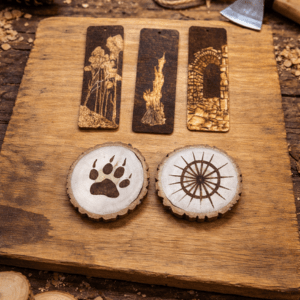
The Grimm Collection doesn’t begin with designs.
It begins with symbols.
Symbols are older than language. They carry meaning across cultures, eras, and personal histories. They don’t explain themselves, and that’s what makes them powerful.
Each piece in the Grimm Collection centers on a symbol that continues to show up in human storytelling, ritual, and transformation. Not because it’s trendy, but because it works.
Below is a closer look at the five core symbols in the Grimm Collection—and why they matter.

The Tree: Roots, Memory, and Endurance
The tree is one of the oldest symbols humanity has ever used.
It represents:
- Connection between worlds (earth, sky, and everything between)
- Ancestry and lineage
- Stability through change
In the Grimm Collection, the tree isn’t ornamental. It isn’t symmetrical or polished. It’s grounded.
As a wood-burned bookmark, the tree becomes a companion through stories, marking your place, returning you to where you left off. It reminds us that progress doesn’t always look like movement. Sometimes it looks like staying.

Fire: Transformation Without Apology
Fire doesn’t ask permission.
It consumes. It transforms. It leaves behind what matters and removes what doesn’t.
In folklore and mythology, fire is both destroyer and creator. It’s the moment everything changes.
The Fire bookmark in the Grimm Collection captures movement and contrast, burned deeply into the wood, embracing variation rather than control.
This piece resonates with people who have crossed a line they can’t uncross. Who have burned something down in order to move forward.
Fire isn’t comfortable. It’s honest.

The Arch: Thresholds and Becoming
An arch is not a destination.
It’s a passage.
Arches appear in ancient ruins, sacred sites, and storytelling because they represent transition, the moment between what was and what comes next.
As a bookmark, the Arch symbol sits quietly between pages, mirroring the way thresholds show up in real life: quietly, without ceremony, waiting for you to notice.
The Arch piece is for those standing on the edge of change, even if they can’t name it yet.

The Paw Print: Instinct, Loyalty, and Companionship
The paw print is one of the most personal symbols in the Grimm Collection.
It represents:
- Instinct over intellect
- Loyalty without conditions
- Presence in the moment
Burned into a natural wood slice, the paw print becomes either an ornament or a coaster, both forms rooted in daily life.
This piece is often chosen by those who understand companionship as something felt rather than explained. It honors the quiet bonds that shape our routines and anchor us.

The Wheel: Cycles, Direction, and Return
The wheel is not about speed.
It’s about continuity.
It symbolizes:
- The rhythm of seasons
- The return to self
- Forward motion without linear pressure
In the Grimm Collection, the Wheel Sigil is steady and grounded, burned into wood meant to be touched and used.
This piece often finds its way to people at a crossroads. Not because it offers answers, but because it acknowledges movement.
Why These Symbols Endure
Trends come and go. Symbols endure because they reflect lived experience.
The Grimm Collection doesn’t assign meaning, it invites recognition. These pieces work because they mirror something already present in the person holding them.
That’s what makes them powerful.
Leave a Reply