
I learned early how to pack fast.
Not in the fun, spontaneous road-trip way, but the kind where you keep your most important things close, just in case. Shoes by the door. Jacket ready. Nothing too precious that you’d miss it if it disappeared.
When you grow up in foster care, permanence is theoretical. You don’t assume continuity. You learn how to read rooms quickly, adjust your tone, and not ask for more than what’s offered. You learn how to be agreeable. Capable. Quietly useful.
You also learn how to rely on yourself in ways most children never have to.
At the time, I didn’t call it resilience. I called it normal.
Independence Isn’t Chosen When You’re Young, It’s Assigned
People love the idea of independence. It sounds empowering. Clean. Confident.
But when independence comes early, it’s not romantic. It’s practical.
It looks like figuring things out without instructions. It looks like not waiting for permission. It looks like learning how to make yourself small enough not to be a problem, and strong enough not to fall apart when no one is watching.
There were moments of kindness. There were people who tried. But the throughline was always the same: Don’t expect too much. Handle it.
So I did.
The Cost of Being “Fine”
Here’s the part people don’t talk about when they praise resilience: it’s expensive.
When you’re used to adapting, you don’t always notice when you’re tired. You don’t always recognize when you deserve rest, support, or softness. You’re good at pushing through, but not always at stopping.
I became someone who could handle a lot.
But I also became someone who didn’t ask for help easily.
That pattern followed me into adulthood. Into parenting. Into work. Into every space where being capable was rewarded and being vulnerable felt risky.
It took me years to understand that survival skills don’t automatically translate into sustainable ones.

Where Making Things Entered the Picture
I didn’t have a lot growing up. But I learned how to make things.
Sometimes it was out of necessity. Sometimes boredom. Sometimes it was just the quiet relief of doing something with my hands that didn’t require explanation. Oftentimes, it was to tune out the noise that was my trauma.
Making gave me control without chaos. It let me decide where a line went. How something came together. When it was finished.
That mattered more than I realized.
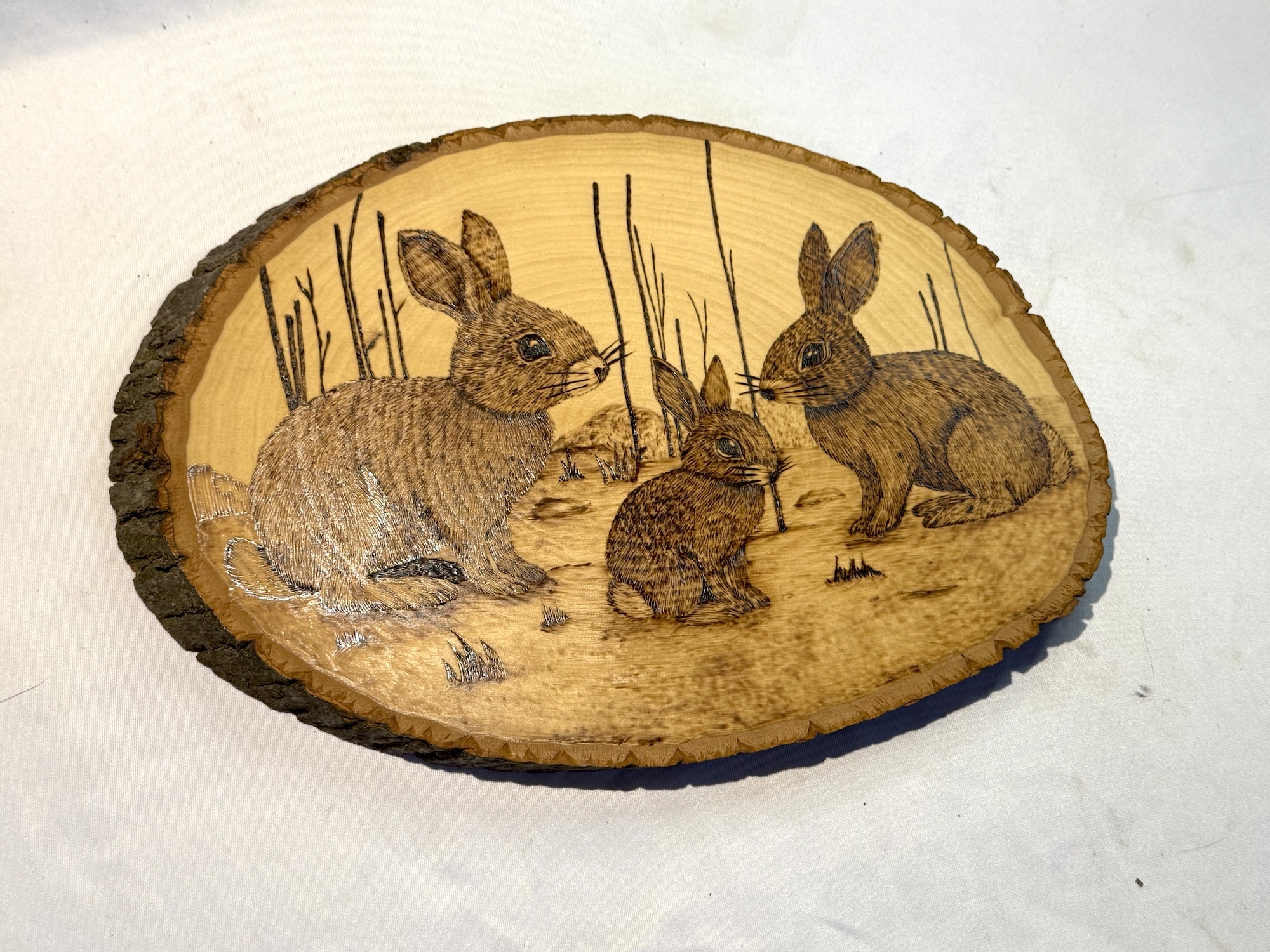
Years later, when I found pyrography, that same feeling returned, stronger and clearer. Fire didn’t care where I came from. Wood didn’t ask me to justify myself. The process didn’t reward pretending.
It rewarded attention.
Resilience Is Not the Same as Hardness
This is something I had to unlearn.
Growing up, resilience meant staying composed. Being useful. Not breaking down. Not needing too much.
But real resilience, the kind that lasts, has room for softness.
It allows for pauses. For recalibration. For mistakes that don’t disqualify you from continuing.
Fire taught me this in a way nothing else had.
You can’t bully wood into cooperating. You can’t rush it without consequences. You have to read it, respond to it, and accept its limits.
That felt familiar, but also corrective.

The Moment I Realized I Didn’t Have to Prove Anything Anymore
There wasn’t a single dramatic breakthrough. No “healing montage.”
There was just a slow shift.
I stopped measuring my worth by how much I could endure.
I stopped assuming I had to earn rest by exhaustion.
I stopped confusing independence with isolation.
Creating art, especially slowly, intentionally, gave me permission to choose steadiness over survival mode.
And that choice changed everything.
How This History Lives Inside My Work
My art doesn’t shout. It doesn’t perform.
It holds.
I’m drawn to grounded imagery, trees, animals, roots, and trails, because they reflect the kind of resilience I believe in now. The kind that grows quietly. The kind that bends without snapping. The kind that doesn’t need applause.
When I burn wood, I’m not trying to dominate the surface. I’m working with it. Responding instead of forcing. Allowing imperfections to become part of the story.
That approach didn’t come from a textbook or a trend.
It came from a life that taught me what happens when you’re forced to be strong too soon—and how healing begins when you’re allowed to slow down.

What Foster Care Ultimately Taught Me
It taught me how to survive.
But more importantly, it taught me how much I value choice.
Choice to stay.
Choice to rest.
Choice to make things on my own terms.
It taught me that resilience without self-compassion eventually burns out. And that strength doesn’t have to look like constant motion.
Sometimes it looks like presence.
Sometimes it looks like care.
Sometimes it looks like letting something take the time it needs.
A Quiet Invitation
If you’re someone who learned early how to hold yourself together.
If you’re strong, capable, and tired of pretending that’s all you are.
If you’re drawn to work that feels steady instead of sharp.
This might be for you.
Not as a symbol of toughness.
But as a reminder that you don’t have to earn rest by suffering.
Growing up in foster care taught me how to endure.
Making art taught me how to stay.
And somewhere between the two, I learned this:
Resilience isn’t about how much you can carry.
It’s about choosing what you no longer have to.
Leave a Reply